



Blog Details
What are the advantages of forging over casting?
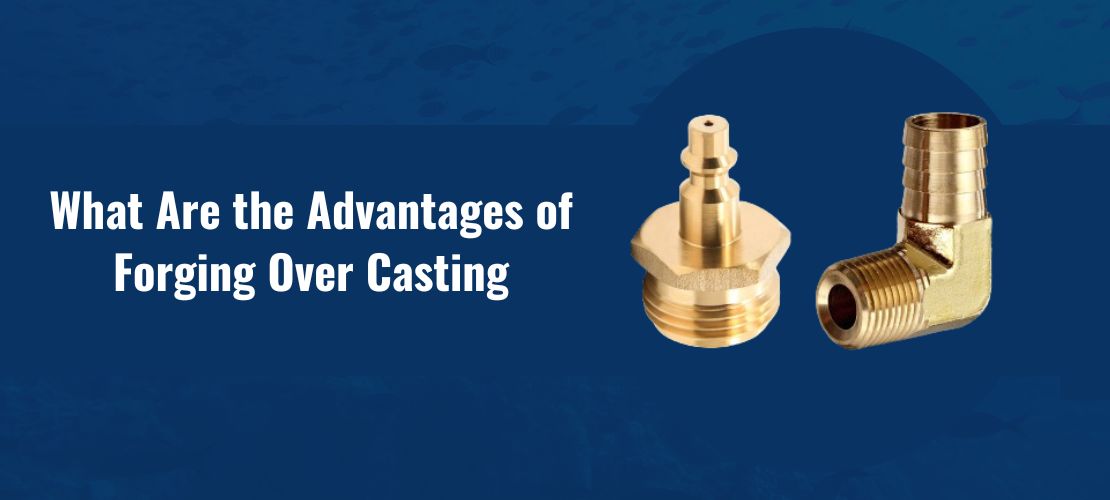
This question commonly arises when industries evaluate the most efficient manufacturing methods for producing brass components. In India, where demand for high-quality brass parts is growing rapidly, understanding the differences between forging and casting is essential.
Today, forging as well as casting is almost entirely conducted in an industrial setting employing sophisticated tools. That has pretty much relegated the blacksmith’s work to the background for every kind of project, save for unique or extremely specialized ones.
But at least it is nice to know the differences and theories of these two forms of metalworking. This blog will look at why forging is a preferred method of manufacturing, particularly where strength and uniformity of the material are necessary.
What is Casting?
Casting is also a metal-working process where you melt the metal until it turns into liquid. In the form of liquid, you can give it the shape that you desire through a mold that is usually used in the process.
Although there are several types of casting you can select for metal casting, the most common ones are three in number. Any of the three techniques namely;
- Investment casting
- Sand casting
- Die casting
What is Forging?
Forging is a manufacturing process that shapes metal using compressive forces, often combined with controlled heating, while the metal remains in a solid state. This process is the one that gives the steel your desired shape but with the added feature of still being in a solid state.
Depending on the methods used it is divided into open die forging, closed die forging, and rolled ring forging. But also according to the temperature used in the process, (cold, warm, or hot forging). Still, forging brass metals varies depending on the forging metal type in items such as bronze, aluminum, brass, or steel among others.
Advantages of forging over casting
1. Better tensile strength and maximum durability
Among the main benefits of forging, as compared to casting, is the attainment of improved material strength. Forging significantly improves tensile strength and durability by refining the metal’s grain structure under high pressure. This process eliminates internal voids and enhances the mechanical properties of forged brass components compared to cast parts. This process improves the mechanical properties of forged brass components than those of conventional cast brass parts.
2. Enhanced Structural Integrity
In general, it can said that forged parts are stronger than casting parts due to the forced fibrous structure. Forged components offer superior structural integrity because the metal’s grain flow is aligned with the shape of the part. Unlike casting, forging avoids defects such as porosity, shrinkage, and internal cracks. On the other that, forging deforms the material which helps in the right direction of the grain in the shape of the part.
3. Better Surface Finish
Another important benefit of forging over casting is the high rough surface that is acceptable as compared to other refined casting works. The casting of forged brass parts enables machinists and metallurgists to achieve neater parts that require the least finishing. This advantage is particularly appropriate for industries in the Indian context, where the need for cost-efficient and quality production has become a critical success factor.
4. Improved Wear Resistance
Forging enhances wear resistance by producing a finer and more uniform grain structure, making forged brass components ideal for applications involving friction or harsh operating conditions. it will effectively be used where it will be used under friction or in more harsh conditions. This makes forging more suitable because it provides a fine grain structure than does the casting, and hence it has better resistance to wear and tear. This makes forged components to be more preferable for long and consistent performance.
5. Cost Efficiency in the Long Run
As with typical aspects, casting may be cheaper than forging in the initial stages however, in the long run, forging usually gives a greater return than the castings. Original forged parts need less frequent repairs and replacements because they are more reliable than automotive built-up parts.
6. Environmental Benefits
In India where awareness about environmental issues is drawn, forging is perceived to be the better choice than casting. Again, the forging process involves small wastage, in energy requirements, and least on the number of processes that have to be carried out once the forging process is complete. In a way, through forging, industries help to decrease the overall level of emissions and pollute the environment while offering products of top quality.
Conclusion
In summary, to study what are the advantages of forging over casting are as follows. The answer is to be found in the fact that forging is stronger, more durable, structurally sounder, and, indeed, cheaper. In the context of Indian industries where quality and sustainability are on the rise, forging brass results are the most suitable. Forging thus offers the best way of manufacturing parts that afford minimum performance and reliability by companies.
FAQs
Q1. What is forging in metal manufacturing?
Ans: Forging is a method that employs compressive force to shape hot metal, resulting in the improvement of strength and grain structure.
Q2. What is casting in metal manufacturing?
Ans: Casting is the method of forming by pouring molten metal into a mold and letting it cool to get an automatically scattered area of complex shapes.
Q3. Why are forged components stronger than cast components?
Ans: Forging sets the grain structure of the metal and minimizes the number of defects within the material, thus giving higher strength.
Q4. Can casting produce more complex shapes than forging?
Ans: Certainly, casting breaks up the limitations of the forging process and grants access to intricate and very complex designs.
Q5. Which process offers better durability, forging or casting?
Ans: Generally speaking, forging is the winner when it comes to durability and longer service life over casting.
Q6. Are cast parts more prone to defects than forged parts?
Ans: In a way, yes; casting might have imperfections like porosity or air pockets, while forging has mostly defective-free internal areas.
Q7. Which is more cost-effective, forging or casting?
Ans: Casting needs less in terms of initial cost, but eventually, it is more economical in the long run because of the durability of forging.
Q7. When should forging be preferred over casting?
Ans: If the application is high-pressure, high-strength, and safety-critical, then forging is the option to go for.